Exhibition · 종로구, 서울시
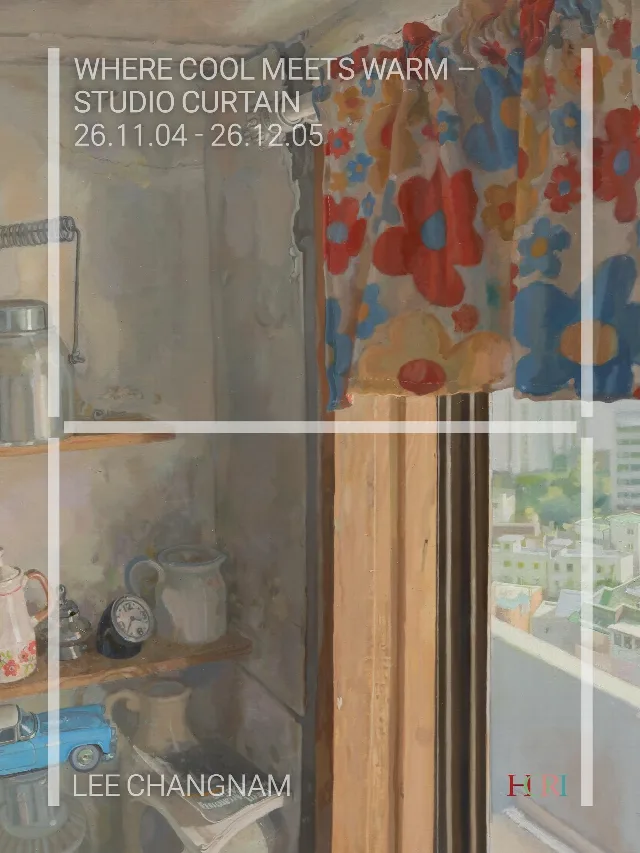
Where Cool Meets Warm – Studio Curtain
DatesWed, Nov 4 – Sat, Dec 5, 2026All dates and times are Korea time (KST)
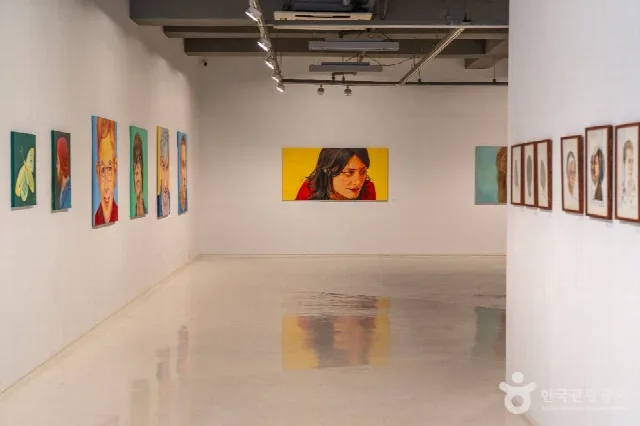
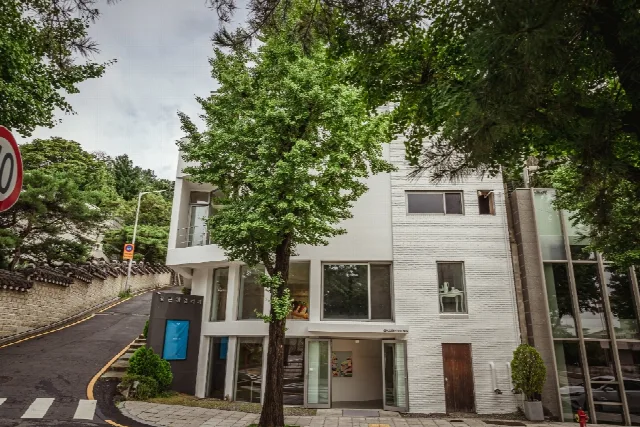
VenueHori Art Space11 Samcheong-ro 7-gil, Jongno-gu, Seoul서울특별시 종로구 삼청로7길 11
PriceAdmissionFree
Weather during the dates
Past days: KMA observations · coming days: forecast (as of 11.20 02:15)
About
The Painter as Perceiving Subject: The Paintings of Lee Chang-nam
To paint by hand a scene seen with the eyes is an act like acrobatics. Realizing what the eyes perceive through the sensation of the fingertips, with paint as the medium, is the result of honing highly refined human abilities even more than tightrope walking or the flying trapeze. The very moment we open our eyes, we convert the space spread before us into information such as distance and color according to rules already agreed within us, and pass it on to ourselves. Instantaneous encoding and decoding (解讀) of space and light and shade, as an extension of my body, are constantly taking place. That is why we know how far to reach out to grab a mug, and know that dim stains are shadows, not something smeared. Yet this perfect system, in which my eyes and perception deliver information every moment, exists only within me. It is an internalized circuit in which signals received through the senses connecting me to the outside are interpreted and concluded through my perception. So the painter's work of drawing this information system built within out into the world through painting, laying it out so that others can recognize it and empathize, cannot be anything but a great visual-perceptual and pictorial challenge, demanding a complex and endless accumulation of practice beyond an acrobat's training.
Lee Chang-nam's canvases give me a slight chill every time I see them. That is because inside the rectangular area set by the canvas frame, a logical structure systematized to units of one in several thousand or tens of thousands stands perfectly. Viewed as a whole, the canvas is filled with exquisite choices of color and touch that make it impossible to see each color as anything but exactly right for that spot. In a painting of roses in a glass vase, for example, that order is overwhelming. More convincingly than reality, he deploys his perfect rhetoric to prove that there is a transparent glass vase, that it holds water, and that several pink roses are arranged in it. Because the buds facing us are closest to us in the picture, the spaces between the layered pale pink petals are rendered more densely with light and shade and fine surface treatment using lilac, apricot and crimson tones, giving a sense of volume as if they were stepping out toward us. By contrast, in the middle and lower part of the canvas, hazy, soft light-gray stains appear as bright flower shadows created when a white wall reflects darkness on a bright day, making the wall feel far away. The light sky-blue highlights representing the glass and the light-green touches where transmitted light falls on the rose stems submerged in water all play their parts. Counted in brushstrokes, it is a puzzle of hundreds of thousands of pieces calmly assembled without error. It has the power to make you hold your breath for a moment as you look at it.
Merleau-Ponty says: "If the painter is to express the world, the arrangement of his colors must carry with it this indivisible whole, or else his picture will only hint at things and will not give them in the imperious unity, the presence, the insurpassable plenitude which is for us the definition of the real. That is why each brushstroke must satisfy an infinite number of conditions... Expressing what exists is an endless task." In Lee Chang-nam's canvases one can even feel a sense of responsibility, as if he were seeking the exact truth inherent in the picture. This sensation, a causal chain between things and the artist in which chance is not permitted, is his mode of existence.
That is why, encountering his canvases, we realize that the perception of space received by the artist's eyes, that is, a space made real through the artist, surely existed. This is a truth and reality beyond comparison with, for example, photography. Photography compresses the world into two dimensions mechanically. In other words, it is just another system that has completed its own encoding by means of optics and chemistry, an alienated image far from reality. With digital photography, this alienation is even deeper, since it is merely an illusion created from a collection of information. But unlike photography, the reality the artist sees directly with his own eyes can be built into space through him. That is his space, and in Merleau-Ponty's terms, he himself becomes that space. By perceiving space, he comes to possess it, which is essential for building pictorial order within the canvas. This is why Lee Chang-nam repeatedly paints his own studio, where he spends most of his time. This place is what his perception has built, that is, it is also himself. One could go to Everest and bring back photographs, but images obtained that way are not his world. He says, "Where I am born and where I disappear, that place is my universe."
Let us look at the paintings with curtains that are drawing attention in this exhibition. The curtain, camouflaged with primary-color floral patterns, pretends to be ordinary, but for the artist it seems at some point to have become a phenomenological threshold dividing the universe realized within him from what lies outside, the non-universe. The window frame where the curtain hangs therefore has an intense presence, as if dividing the stained walls of the studio from the bright view outside, making us look at the boundary between light and darkness. The artist's studio has an outdoor space, and the works looking out from there extend his world. The villas seen below the hill of Geumho-dong, the vertical new apartment towers, and beyond them the Han River flowing horizontally and the buildings of Gangnam test where the limits of his visual perception lie. Recording the changes in the buildings in between over some ten years, this piece of Seoul, a space experienced by the artist, reminds us of the artist's body and the world as its distant extension, that is, the outside. Even within this complex picture, the bright, delicate touches rendering the buildings as if steeped in sfumato are again incredibly precise and orderly. Might not this scene, occupying his body and his perception, have been painted by drawing it into him, or rather by his once again lending his body to the world?
Jung Shin-young, Assistant Professor, Seoul Women's University
- Contact
- +82 2-511-5482
Directions
Hori Art Space
11 Samcheong-ro 7-gil, Jongno-gu, Seoul
서울특별시 종로구 삼청로7길 11
 Naver Map
 KakaoMap
 TMAP
 Google Maps
Things to do nearby
Closest to the venue first

Nearby info & photos: Korea Tourism Organization
Festivals nearby
On now or coming soon · nearest first



Info: Korea Culture Information Service — dates may change, please check with the organizer