Exhibition · 강남구, Seoul
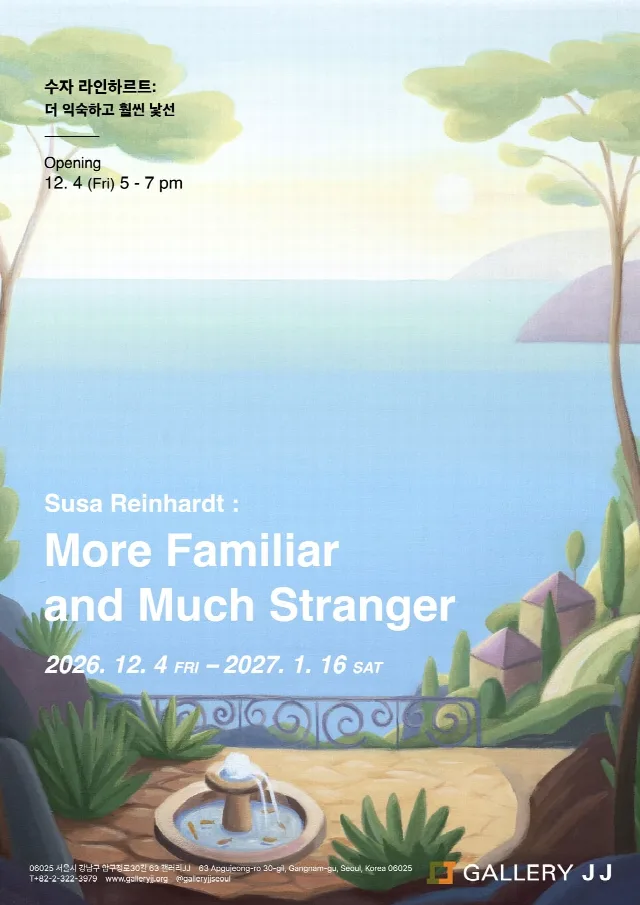
Susa Reinhardt: More Familiar and Much Stranger
DatesFri, Dec 4, 2026 – Sat, Jan 16, 2027Tuesday–Saturday 11:00~19:00Monday visits by reservationAll dates and times are Korea time (KST)
VenueGallery JJ63 Apgujeong-ro 30-gil, Gangnam-gu, Seoul서울특별시 강남구 압구정로30길 63 서울 강남구 압구정로30길 63
PriceAdmissionFree
About
More familiar and much stranger
Gallery JJ presents Susa Reinhardt: More Familiar and Much Stranger, the first solo exhibition in Korea by Susa Reinhardt (b. 1967), an artist based in Stuttgart and Berlin, Germany. Reinhardt is well known for her calm, idealized landscape paintings. Focusing on using painting to create an atmosphere that uplifts the mind and offers tranquility, she has built a distinctive pictorial language of her own. Her landscapes explore our senses and visual perception within the pictorial space, and lead on to a reflection on the relationship between nature and humans, that is, on the world.
Centered on her latest works, the exhibition presents some 20 of her signature landscape paintings, including a number of drawings and paper collages. Reinhardt's work makes us look again at the 'landscape painting' we usually assume we know well. The dreamlike, beautiful stage of nature she invites us into is more familiar than we think, and much stranger.
In today's fast-paced digital environment, where artificial intelligence pours out images, 'landscape painting' may, somewhere in people's preconceptions, wear the worn-out, clichéd image of an old classical genre. In the late 20th century abstraction and Pop Art dominated painting, and painting itself was pushed aside by practices such as conceptual art, performance and installation, yet the subject of landscape always existed alongside other concerns. Landscape blended into abstract art, for example, and was also one pillar of Land Art. In Landscape Painting Now (2019), the critic Barry Schwabsky states that the landscape subject is in fact flourishing even more today. Landscape painting is being made anew with each artist's own concept of landscape, and painters do not shy away from the fact that a painting is simply 'pretty pictorial' but rather enjoy it. Reinhardt's landscapes show yet another facet among the many possibilities of 'contemporary landscape painting.'
The artist looks at landscape through the conceptual lens of a 'cultural construct.' Landscape, in other words, is a visual code and frame formed through socialization and within cultural and historical contexts, a construct in which many symbols are combined. The motifs that recur in Reinhardt's paintings, such as lakes, gardens, trees and forests, reveal that our perception of nature is constructed through identification and classification, and raise questions about our relationship with nature.
She offers an alternative to traditional landscape painting with its romantic, mystical and monumental character. Focusing on pictorial spaces that can evoke comfort, openness and well-being, Reinhardt integrates influences from popular visual culture such as animation, comics and Pop Art. The more one looks at her artificially neat scenes of nature, the more they appear to be pastoral utopias rather than real places, and beyond their peacefulness they reveal the inner human desires projected onto nature and the cultural signs shaped by the times. She draws on the tradition of landscape painting, yet creates images of nature with new concepts and methods.
After studying stage design at the State Academy of Fine Arts Stuttgart, the artist completed the Meisterschüler program in painting under Joseph Kosuth, renowned as a conceptual artist. While still a student in the early 1990s, as a member of the collective 3K-NH, she experimented with conceptual, public-facing 'new-pop' painting together with artists including Michel Majerus. It was a collaborative practice that actively appropriated the visual signs of modern capitalism, from popular culture and advertising logos to video games and pop music, reinterpreting them with a 1990s sensibility distinct from the Pop Art of the 1960s. From around the 2000s to the present she has fully developed her own original world of landscape painting, while the pop painting of that period continues today in another series built on everyday moments. This experience of conceptual art and pop appears to have strongly shaped the conceptual thinking with which she connects art and reality. Her works are held by major institutions including the Kunstmuseum Stuttgart and Mudam Luxembourg.
Reinhardt's painting expresses a distinctive aesthetic through stylized elements and soft colors. It is a crystallization that fascinatingly combines the experiences she has accumulated over many years, from painting and stage design to conceptual art, animation and Pop Art. Post-pop in the way it consciously schematizes existing images and the forms of popular culture, it allows conceptual coolness and a longing for utopia to coexist without cancelling each other out.
Ⅰ
The smooth surfaces built up from thin layers of oil paint, the consistently warm pastel tones and the simple compositions let viewers briefly escape reality and feel a peaceful, dreamlike atmosphere. A subtle stillness hangs over the fairy-tale-like yet impeccably ordered empty spaces, and the scenes feel somehow surreal. The places seem lyrical but are artificial, giving the sense of a virtual space or an unfamiliar place. Titles made up of words such as 'Mirage, Haven, Dream' hint at this as well. Reinhardt's painting is not a naturalistic attempt to reproduce nature realistically. According to the artist, her paintings are inspired by her frequent travels in Italy, but rather than depicting specific places they are spaces of condensed memory, observation and imagination. She has also made many sketches in oil pastel while traveling. The air and natural atmosphere of Italy were for her the starting point of an unhurried kind of landscape painting and a leisurely encounter with nature.
To see nature is to reorganize nature's disordered data into familiar, ordered forms. According to Kant, we do not see objects 'as they are' but through the cognitive frameworks of our minds. Through formal reduction and a stylized, condensed visual language, Reinhardt actually emphasizes that our visual perception is a synthesis of regular processes of identification and classification.
Her work goes through a process of reduction and refinement. For simple compositions that leave out the details of the landscape, the shapes of each element, such as trees, houses and lakes, are replaced by single fields of color, and the collages shown in this exhibition play an important role in this process. Before painting in oil, the artist works out a harmonious and precise arrangement of color fields through collage, cutting and pasting papers painted in various colors to select each color carefully. As a result, every motif settles into a clear, pure form without any trace of correction. In the exhibited works (2026) and (2026), the clear sky, the blue lake in the middle and especially the trees lined up on both sides naturally lead the eye from nature to artificial elements such as houses and roads. Simple yet regionally distinctive forms familiar to our eyes, such as pointed red roofs and roads lined with cypress trees, as well as the trees, clouds and hills in the pictures, are not realistically depicted objects but signs pared down to their simplest form so that they can be recognized at once.
The way we see and understand nature works in the same way, as a reconstruction through the filter of perception. Looking at humanity's historical attitudes toward nature, there is a long-held view of nature as a place of rest, a place of comfort that gently embraces us. From ancient landscape murals painted for rest and entertainment to the Renaissance, landscape painting was at times regarded as offering pleasure and psychological calm in place of the experience of real scenery. There was the 'picturesque,' nature that looks like a picture, which originated in the landscapes of Claude Lorrain in the 17th century and became an established taste in the 18th century, and in the industrial age nature was idealized as a refuge from harsh city life. Unlike Western painting, where landscape long played a secondary role, East Asian landscape painting, for which landscape was fundamental, likewise sought to express the joy of spiritual wandering and a world of absolute freedom through the idea of 'wayu' (臥遊), traveling with the eyes while lying down and roaming leisurely through pictures.
The more idealized a place is, the more unreachable it becomes, and that distance makes the pictures all the more beautiful. The artist builds these images with utterly lovely colors, an animation style, soft contours and scenes in which animals or people occasionally appear. Her paintings contain utopian elements: an archetypal place inherent in the human unconscious and epitomized by Arcadia, a space of healing. It is close to an unattainable ideal onto which inner longings are projected. In short, the surface pastoralism of her paintings reflects the human desire to imagine nature as a beautiful and comfortable place of rest.
In this way Reinhardt's landscapes carry on the familiar tradition of 'picturesque landscape painting.' At the same time, by scattering and isolating individual elements on the canvas and using backlit, contrasting forms and a flat sense of space, they create a certain unease and unsettle the pastoral fantasy. They remind us once again that this is a utopia and, in its artificial strangeness, a world that is not real and that we cannot reach. The paintings reveal a subtle reflection on the idealized image of traditional 'redemptive, pastoral nature.'
Ⅱ
The spatial composition, too, borrows both from the compositions of historical landscape painting and from the background staging of classic animated films. Trees that open the scene from both sides and a path leading inward resemble both a typical landscape composition and the structure of a stage. The landscape is the protagonist of the picture and at the same time recedes into the background, becoming a stage for each viewer's inner stories. Natural scenery is the subject, while the empty scenery, with no one in it, works as a backdrop to be filled entirely by the viewer's imagination. It was around the 17th century that landscape, long confined to the backgrounds of Western painting, began to be recognized as an independent genre; even then it was treated as a backdrop for the narratives of history painting or as a minor genre, before being raised to a major subject in the Romantic era and reaching its peak with Impressionism. In Reinhardt's pictures, both roles of landscape, subject and background, intersect. Schwabsky criticized the view of nature as a stage for humans, but by openly constructing her scenes like a stage, Reinhardt emphasizes that very way of looking. What her teacher Joseph Kosuth wrote in a 1996 letter of recommendation, that Reinhardt's work turns 'discomfort' into 'comfort,' still seems true of her work today.
Recently, as seen in the work (2025), her once-deserted landscapes have come to show people resting and meeting one another in well-tended gardens and squares. Short, illustration-like scenes and a series of pop-style paintings that look like snapshots also create the artist's characteristically bright and distinctive mood, sharing quiet and joyful everyday moments with viewers. Hoping that painting can slow down the speed of perception, the artist holds on the canvas ordinary moments that are easy to pass by.
As the conditions of life change rapidly, the concept of landscape seems to be growing ever more necessary and important. As people lose things to urbanization, and as communication with nature becomes urgent, thinking about and expressing landscape is unfolding in many ways, from Anselm Kiefer's new Romantic landscapes and David Hockney's post-pop landscapes to the abstract terrains of Shara Hughes and Julie Mehretu. Perhaps in the 21st century landscape has become a heavier concept because of the climate crisis. From the modern point of view, nature was landscape, an object for us to look at. Humans were spectators outside the frame, and nature was the passive backdrop against which the human drama unfolded. The philosopher Bruno Latour opposed the dualistic thinking of subject and object, culture and nature, which sees the non-human world purely from the human point of view. Contemporary art, too, rather than idealizing nature as something infinite, has come to intervene actively in nature, or to see nature as the environment we belong to and explore the material conditions of the Earth.
Instead of intervening directly in nature, Reinhardt brings that very 'gaze from outside the frame' onto the canvas. Slow, quiet pictures. Her landscapes still look romantic, but she disrupts this by revealing on the canvas the picture itself, divided, bounded and framed. Like scenes in postcards, animation and old landscape paintings, it
- Contact
- +82 2-322-3979
- Closed
- Sundays, Mondays
Directions
Gallery JJ
63 Apgujeong-ro 30-gil, Gangnam-gu, Seoul
서울특별시 강남구 압구정로30길 63 서울 강남구 압구정로30길 63
 Naver Map
 KakaoMap
 TMAP
 Google Maps
Things to do nearby
Closest to the venue first


Nearby info & photos: Korea Tourism Organization
Festivals nearby
On now or coming soon · nearest first





Info: Korea Culture Information Service — dates may change, please check with the organizer