Exhibition · 강남구, Seoul
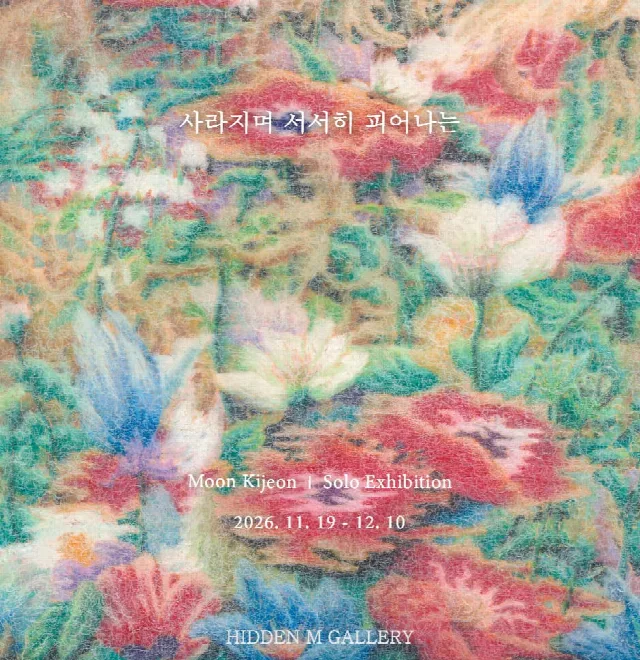
Slowly Blooming as It Fades
DatesThu, Nov 19 – Thu, Dec 10, 2026All dates and times are Korea time (KST)
Venue히든엠갤러리16 Nonhyeon-ro 86-gil, Gangnam-gu, Seoul서울특별시 강남구 논현로86길 16 서울 강남구 논현로86길 16
PriceAdmissionFree
Weather during the dates
Past days: KMA observations · coming days: forecast (as of 11.21 07:15)
About
From November 19 to December 10, Hidden M Gallery presents Moon Gi-jeon's solo exhibition "Slowly Blooming as It Fades." The exhibition brings together works that trace how landscapes experienced while traveling and in daily life remain in the senses and memory, change over time, and bloom again as new images. Rather than reproducing the scenery before the eyes as it is, Moon focuses on what traces the light, wind, temperature and movement experienced there leave within, and in what form they come back to life. Landscapes once experienced fade in memory over time and return in a form different from the original.
Moon's work has long started from questions about the senses, consciousness, and the "self" as the subject who perceives the world. The artist is interested in the countless phenomena that occur within a single living being, exploring how we sense and perceive the world and build our own reality. A vague fear of darkness experienced in childhood grew into fundamental questions about life and death, which in turn led to questions such as "What is this world, and what am I?" and "Why do I sense, perceive and communicate with the world this way?" These reflections developed into an interest in how the reality we experience takes shape as external stimuli are passed to the senses and interpreted and reconstructed by the brain. For the artist, the senses are not a simple channel for taking in the outside world but a process in which each person's experiences and memories combine to create a new world.
The artist's exploration of how the senses and consciousness are formed takes concrete shape in the "Afterimage of Light" works. Moon focuses not only on visual afterimages but on how various senses, including hearing, touch, smell and taste, are generated and interpreted in the brain. Information from outside travels to the brain through electrical and chemical signals flowing along nerve cells, where it is intricately reconstructed into a single sensation and consciousness. The artist has visualized this process in images that recall tangled neurons and synapses and the flow of neural signals. In particular, the trace of light that lingers for a while after we close our eyes shows that sensations and memories can persist and transform even after the external stimulus is gone. For the artist, light is a medium that reveals the moment when the outside world meets inner perception, and a starting point for asking how the reality we experience is formed.
Moving beyond this inquiry into the senses and consciousness, the exhibition looks at how landscapes actually experienced change in memory and form new images. For the artist, a landscape is not just the scene spread out before the eyes. Nature encountered on a trip or moments that brush past in daily life gradually fade with time, but the sensations and emotions experienced in them do not disappear completely. Some scenes remain as vivid images, while other moments are remembered only as a vague mood or impression, having lost their concrete form.
The artist focuses on the process by which these fragments of experience left in memory meet other inner memories, transform over time, and appear as new landscapes. In this process memory and imagination intersect, and scenes from the past are reconstructed in a form different from the original. Sensations that went unnoticed come to light, and images that never actually existed are created.
This reconstruction of memory expands into more personal experiences and memories of relationships in the installation "My Mother's Garden." The artist's mother always poses with flowers whenever she has her photo taken. When the artist asked why, the mother gave a short, simple answer: "Because they're pretty." That answer and the mother's smile in the photos stayed long in the artist's memory and formed a landscape of their own. Made up of 144 small panels, the work shows how scattered pieces of memory and sensory information gather, connect and create a new landscape. Flowers bloom between the central oil pastel work and the pencil works surrounding it, and the mother, who is never directly drawn, reappears in the inner garden along the path of memory. Here the flowers become a medium that calls up the time and feelings shared with the mother and the sensations of those moments. Through modest everyday memories, the artist shows how vanished moments remain within and come back to life as new images.
What the artist explores in her work goes beyond the visual experience of looking at a landscape to the traces of sensations taken in with the whole body at that moment. Sensations that are hard to fully put into words, such as light and wind, temperature and movement, shape the way we remember a landscape. By giving these sensory afterimages form in the language of painting, the artist creates new landscapes at the point where experience and memory intersect, rather than reproducing the scene in front of the eyes.
"Slowly Blooming as It Fades" captures the process by which the sensations and memories left in vanished landscapes carry over into new images. The landscape before our eyes gradually fades with time, but the sensations and feelings experienced there stay in memory and resurface in a different form. Capturing these traces of memory on the picture plane, the artist shows the moment when a vanished landscape blooms into a new image. Landscapes that begin in the artist's experience also prompt viewers to recall their own memories. Following the colors and forms left on the canvas and the traces of sensation within them, each viewer comes face to face with the landscapes held in their own memory.
Every day we encounter countless landscapes, but we do not remember every moment. Some scenes fade with time, while some moments stay in our hearts for a long time and resurface when we least expect it. Memories revived this way can appear with emotions and images different from the moment first experienced. Following the traces of sensation and memory left in vanished landscapes, the exhibition shows how they change over time and bloom into new images. We hope it will be a time to encounter anew the landscapes held in each visitor's memory.
- Contact
- +82 2-539-2346
Directions
히든엠갤러리
16 Nonhyeon-ro 86-gil, Gangnam-gu, Seoul
서울특별시 강남구 논현로86길 16 서울 강남구 논현로86길 16
 Naver Map
 KakaoMap
 TMAP
 Google Maps
Things to do nearby
Closest to the venue first



Nearby info & photos: Korea Tourism Organization
Festivals nearby
On now or coming soon · nearest first





Info: Korea Culture Information Service — dates may change, please check with the organizer