Bosingak Belfry
Bosingak Belfry
10m from Namsan Beacon Fire Ceremony and Other Traditional Cultural Events
종로구 종로 54
 Great with this festivalNamsan Beacon Fire Ceremony and Other Traditional Cultural Events
About
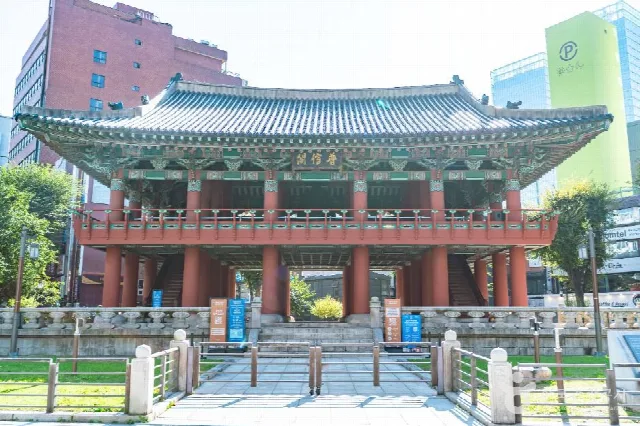
Bosingak Site is where Bosingak, the bell pavilion that announced the time inside and outside the capital walls, once stood. Bosingak, also known as Jonggak, got its name when King Gojong bestowed the name Bosingak in 1895 (the 32nd year of his reign). First built in 1395 (the 4th year of King Taejo), it burned down four times and was rebuilt eight times. The current building was built by the Seoul Metropolitan Government in August 1979 as a two-story pavilion, five bays east to west and five bays north to south. The old Bosingak bronze bell, a Treasure, was cast in 1468 (the 14th year of King Sejo of Joseon) and hung at Wongaksa Temple; after the temple was abandoned, it was moved to the current Bosingak site in 1619 (the 11th year of King Gwanghaegun). The Bosingak bell was struck 33 times at 4 a.m. and 28 times at 7 p.m. to open and close the city gates and mark the time of day. Over the years, cracks formed in its body and it could no longer be rung, so a bell pavilion was built at the National Museum of Korea to house it. The bell now hanging in Bosingak was newly cast in 1985 with donations from the public and first rung on Liberation Day that year. Every December 31, roads around Bosingak are closed to traffic, and the area fills with people gathering to enjoy the bell-ringing ceremony that welcomes the New Year.
Visitor info
- Contact
- Jongno-gu Cultural Heritage Division 02-2148-2032
- Hours
- Always open
- Closed
- Open all year
- Admission
- Free
- Foreign-language guide service
- No
Directions
Bosingak Belfry · Jongno, Seoul
 Naver Map
 KakaoMap
 TMAP
 Google Maps
Festivals nearby
On now or coming soon · nearest first




Sights nearby
Restaurants nearby
Stays nearby
Place info & photos: Korea Tourism Organization TourAPI · Hours and prices may change, please check before visiting · Updated 2026.10.28