Exhibition · 신라천년보고
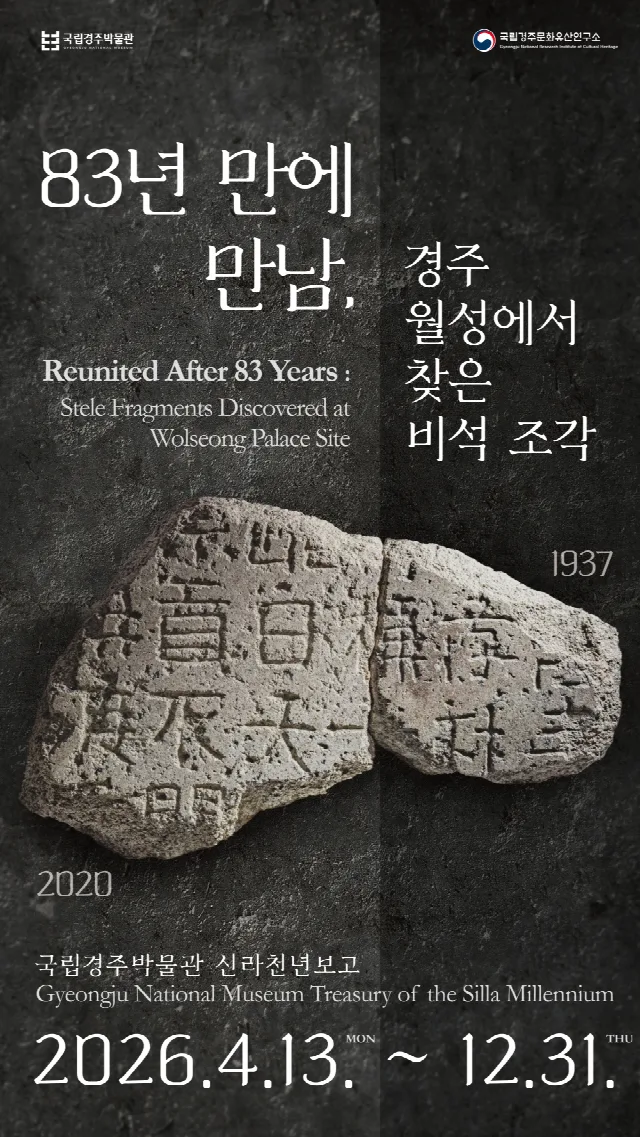
Reunited After 83 Years: Stele Fragments Found at Wolseong, Gyeongju
DatesMon, Apr 13 – Thu, Dec 31, 2026- 10:00~18:00 (last admission 17:30)- Extended night opening 18:00~20:00 (Saturdays, March–October)All dates and times are Korea time (KST)
VenueGyeongju National Museum Silla Millennium Treasury186 Iljeong-ro, Gyeongju-si, Gyeongsangbuk-do경상북도 경주시 일정로 186 국립경주박물관
PriceAdmissionFree
About
In 1937, a broken fragment of a stele was found on the west side of Wolseong Palace Site in Gyeongju. Only the character 存 (jon) could be made out on it; the rest was badly damaged, making it hard to know exactly what the stele said.
In 2020, while the Gyeongju National Research Institute of Cultural Heritage was excavating the defensive moat (haeja, 垓子) surrounding Wolseong, another stele fragment came to light. Slightly larger than the fragment kept at the museum, it bore characters such as 貢 (gong), 白 (baek), 不 (bul) and 天 (cheon). At first, no one expected the two pieces to have broken off from the same stele. During a 3D-scanning survey, however, the broken surfaces of the two fragments fit together exactly, and a character that survived only in halves was identified as 稱 (ching).
Of course, we still do not know what this stele said, or who erected it, for what purpose and where. That is because the surviving information is very limited. Will it be reunited with other fragments as time goes by?
The Mysteries of the Wolseong Stele
Where did the stone come from? Both fragments are alkali granite containing quartz, feldspar and biotite, and provenance analysis has shown that the stone was quarried around Namsan Mountain in Gyeongju. The two fragments now differ in color, perhaps because the fragment recovered in 2020 had been buried underground, while the one found in 1937 was collected from the surface and seems to have been exposed above ground for quite a long time.
Which part of the stele are they? The arrangement of the characters on the fragments indicates that they came from the center of the stele rather than its edges, since traces of further characters can be seen to the left, right, above and below the surviving ones. The inscribed front face is smoothly finished, and a total of 16 characters can be identified: seven are legible, four can be inferred and five cannot be made out.
The Secret of the Script The script carved on this stele is not the regular script (haeseoche)* commonly seen on Silla steles, but clerical script (yeseoche)*. This differs from 6th-century Silla steles, including the Pohang Jungseong-ri Stele (503), the earliest known Silla stele, which use regular script still showing the influence of clerical script. That is exactly why the discovery of a stele fragment using clerical script alone is so intriguing. *Regular script: a style of Chinese characters written neatly and upright without cursive flow. It consists of eight ways of making strokes: the dot, the horizontal stroke, the vertical stroke, the hook, the rising stroke to the right, the long left-falling stroke, the short left-falling stroke and the right-falling stroke. *Clerical script: a style simpler than the seal script used in China's Warring States period and more convenient for everyday writing, characterized by somewhat wide, flat characters.
A Silla stele or a Goguryeo stele? Clerical script is found mainly on Goguryeo steles, and as it happens, the characters 渡 (do), 白 (baek), 稱 (ching) and 貢 (gong) used on the Stele of King Gwanggaeto the Great also appear on these fragments. This has raised the possibility of a connection with 5th-century Goguryeo. On the other hand, some take a cautious view, noting that the Wolseong stele uses granite quarried from Namsan Mountain in Gyeongju, that clerical script was also used in China so the script alone cannot determine the date or kingdom, and that sophisticated surface-finishing techniques appear in earnest only after unification in the 7th century. As the full content of the stele remains hard to grasp, more discussion and debate are needed to determine whether it is a Silla or a Goguryeo stele.
- Contact
- +82 54-740-7537
- Organizer
- 국립경주박물관, 국립경주문화유산연구소
- Closed
- Second Monday of March and November (gardens and outdoor exhibition area open as usual) / January 1 / Seollal and Chuseok
Directions
Gyeongju National Museum Silla Millennium Treasury
186 Iljeong-ro, Gyeongju-si, Gyeongsangbuk-do
경상북도 경주시 일정로 186 국립경주박물관
 Naver Map
 KakaoMap
 TMAP
 Google Maps
Things to do nearby
Closest to the venue first
Nearby info & photos: Korea Tourism Organization
Festivals nearby
On now or coming soon · nearest first



Info: Culture Data Plaza — dates may change, please check with the organizer